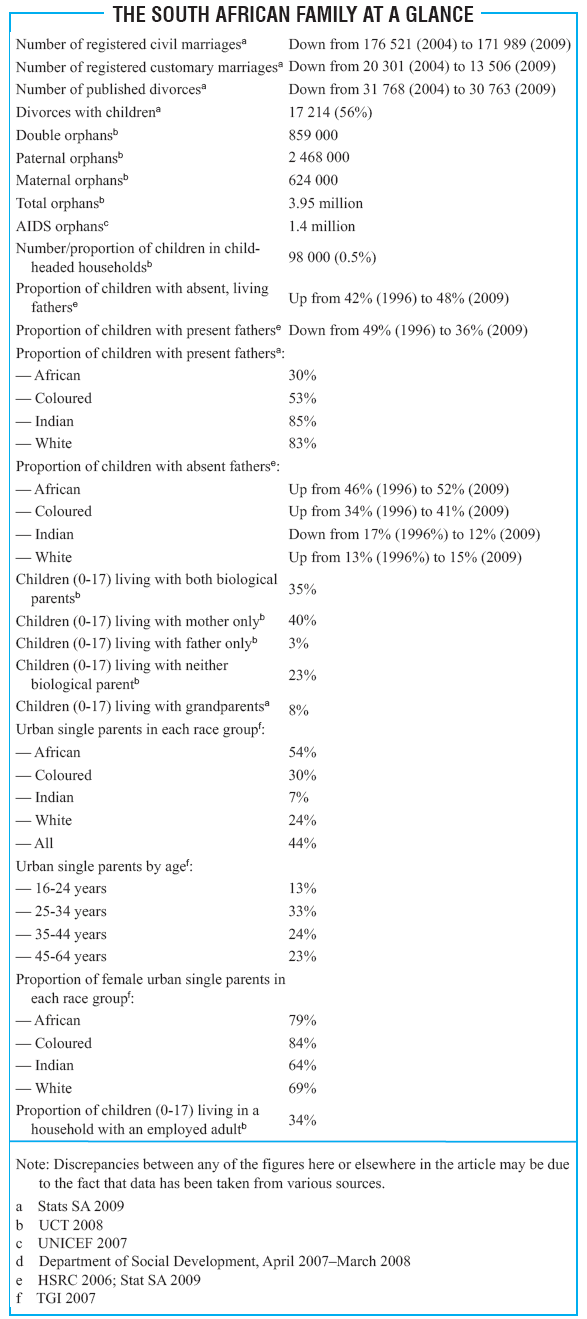
This edition of Fast Facts describes the situation of South African families. The effect of the HIV/AIDS pandemic on families is reflected in the increasing numbers of orphans and child-headed households. More and more children are growing up with absent fathers, and in singleparent households. Children growing up with one parent, or without their fathers, are at a significant disadvantage. Poverty exacerbates the impact of family breakdown on children.
Family life in South Africa has never been simple to describe or understand. The concept of the nuclear family has never accurately captured the norm of all South African families. Thus when we speak of South African families, we talk not only of the nuclear family, but also of extended families, as well as care-givers or guardians. In South Africa, the ‘typical’ child is raised by their mother in a single-parent household. Most children also live in households with unemployed adults.
South Africa has a number of unique circumstances that affect the structure and situation of families. They include its history of apartheid, and particularly the migrant labour system. Poverty greatly affects family life. The HIV/AIDS pandemic has also profoundly affected the health and well-being of family members, and has consequently placed an added burden on to children. Our research aims to highlight how family life in South Africa affects the prospects of children.
The research includes often underacknowledged influences on children and young people that affect many issues in South Africa — from violent crime, through to entrenching a cycle of poverty, as well as the values and norms South Africans hold. We also seek to describe the environment in which children grow up and through which socialisation occurs, in order to understand the influences and effects of social breakdown on families and communities, and ultimately on South Africa as a whole.
Orphans and child-headed households
The HIV/AIDS pandemic has had a profound effect on family life in South Africa and the sub- Saharan region of the African continent. Nowhere is this more striking than in the increase in orphans and child-headed households.
Of the 9.1 million double orphans in Sub-Saharan Africa in 2005, around 5.2 million (almost 60%) had lost at least one of their parents to AIDS. Without AIDS the total number of double orphans in sub-Saharan Africa would have declined between 1990 and 2010.
In South Africa itself, there were 859 000 ‘double orphans’ (children both of whose parents have died), 2 468 000 paternal orphans, and 624 000 maternal orphans in 2008. Levels of violent deaths could help to explain the prevalence of paternal orphans over maternal orphans. More than a third (11 314) of non-natural deaths in 2007 were caused by violence, 87% of which were male. However, this alone cannot explain the high number of paternal orphans, some of whom may also be accounted for by children whose fathers have never been known.
A total of 3.95 million children had lost one or both parents by 2008, an increase of about a third since 2002. The number of double orphans increased by 144%.
Almost half of all orphans, and two-thirds of double orphans, were between the ages of 12 and 17 years.
The United Nations Children’s Fund (Unicef) estimated that in 2007, some 2 500 000 children in South Africa had lost one or both parents due to all causes. Of these children, more than half had lost one or both parents as a result of AIDS. Some 510 000 children had lost both parents as a result of all causes.
By 2015, some 5 700 000 children would have lost one or both parents to AIDS. Some
3 100 000 children under 18 years would be maternal orphans, and 4 700 000 would be paternal orphans, according to the Medical Research Council in 2002.
Although the HIV/AIDS pandemic in South Africa has stabilised, and the infection rate is now starting to decline, the number of orphans will continue to grow or at least remain high for years, reflecting a time lag between HIV infection and death.
This means that although HIV infections are decreasing, the people that are already infected will continue to die once they progress from HIV to full-blown AIDS.
Orphaned children are at a significantly higher risk of missing out on schooling, living in households that have less food security, suffering from anxiety and depression, and being exposed to HIV infection.
These risks are higher if a mother, rather than a father, died.
Widowed mothers were more likely to assume responsibility for the care of their children than widowed fathers — making children who have lost their mothers less likely to live with the surviving parent, compared to those who lost a father. Survival of the youngest children — those aged 0-3 years, was at stake when mothers were dying or had recently died. Such children were nearly four times more likely to die in the year before or after their mothers’ death than those whose mothers were alive and healthy.
A study by the University of Cape Town on the impact of orphanhood on school performance followed children over a number of years. It found that those whose mother had died were less likely to be enrolled in school, had completed fewer years of education on average, and had less money spent on their education than children whose mothers were still alive.
The relationship to the caregiver is very important after the death of one or both parents. A study by Unicef showed that the closer children remain to biological family, the more likely they are to be well cared for, and the greater the chance that they will go to school consistently, regardless of their poverty level.
According to the Department of Basic Education, in 2008 some 481 994 ‘double orphans’ were enrolled in ordinary schools. Another 1 661 275 children whose mother or father had died (single orphans) were enrolled in school.
The number of children receiving the foster child grant increased by 88% between 2005 and 2009 from 271 817 to 511 479.
The grant was increasingly used to provide financial support to caregivers looking after children whose biological parents have died of AIDS. In 2010 this grant was R710 a month.
The experience of orphanhood was compounded for some children who did not have care-givers, and lived in child-headed households.
In 2008 some 98 000 children (0.5%) were living in childheaded households (where all members are younger than 18 years old). This figure has declined since 2002, when 118 000 (0.7%) were living in such households.
Between April 2007 and March 2008, some 23 898 childheaded households received services such as psycho-social support; linking children with relatives and family; or facilitating access to official documents, social grants, and food parcels, from the Department of Social Development. This means that not all children living in childheaded households were receiving assistance from the department.
One assumes that children living in child-headed households do not have either of their parents’ alive. However an article in the journal AIDS Care found that 62% of children living in child-headed households in 2006 were not orphans. Altogether 92% of the approximately 122 000 children living in child-headed households had one or both parents alive.
Some 81% of children in childheaded house-holds had a living mother. The article said that the most likely explanation for this was that parents were leaving their children to travel to other provinces to find work. However, alcoholism and drug abuse among parents were also possible explanations of this trend.
Children living in child-headed households are also assumed to have much lower school attendance rates than children living with parents or other caregivers.
However, AIDS Care found that rates of school attendance were not significantly lower for childheaded house-holds — 95% for child-headed and 96% for mixedgeneration households.
Nevertheless — and unsurprisingly — levels of poverty were higher among child-headed households, 47% of them having a monthly household expenditure of less than R400 compared to 15% of mixed-generation households.
Single-parent households Only 35% of children were living with both their biological parents in 2008. Some 40% were living with their mother only, and 2.8% with their father only, which leaves 22.6% of children who were living with neither of their biological parents.
A breakdown of single parents in urban areas showed certain trends. In 2007, some 44% of all urban parents were single. Some 52% of African urban parents were single, as were 30% of coloured parents, 7% of Indian parents, and 24% of white parents.
An age breakdown of urban single parents showed that 13% were between the ages of 16 and 24 years, 33% between 25 and 34, 23% between 45 and 64, and 24% between 35 and 44.
Some 31% of African urban single parents were unemployed, as were 25% of coloured, 14% of Indian, and 5% of white parents.
Some 79% of African urban single parents were female, as were 84% of coloured, 64% of Indian, and 69% of white such parents.
Thus urban single parents were overwhelmingly African, female, and between the ages of 25 and 34 years. Unemployment rates among urban single parents were also high.
These figures are similar to those in the 1998 South African Demographic and Health Survey, which showed that 44% of firstborn children were born before their mother had been married.
Thus it seems as though the marital status of the parents is very important as to whether the children will have both parents in the household. Children born to unmarried parents are more likely to live in single-parent households, than those with married parents.
Research conducted in the United Kingdom by the Londonbased Social Policy Justice Group shows that single-parent households were two and a half times as likely to be living in poverty as couple-parent households.
The 2001 South African census showed that only 43% of children aged 0-4 years had both parents in the household, as did 42% of children aged 5-13 years, and 42% aged 14-19 years.
Once again there were significant differences between racial groups. In the age group 0-4 years, 38% of African, 56% of coloured, 85% of Indian, and 86% of white children, had both parents in the household. Similar trends were evident in the age groups 5-13 years, and 14-19 years.
The 2001 census showed that 76% of households were made up of nuclear or extended families. The proportion of households that were made up of nuclear families decreased between 1996 and 2001, from 46% to 40%, while the proportion of households made up of extended families increased from 32% to 36% over the same period.
All race groups saw a rise in the proportion of households with extended families over this period.
Among Africans there was a decline in the proportion of singleparent households, but an increase in the proportion of single parents living with relatives.
For all race groups excluding white people, there was a decrease in the proportion of households comprising a couple and children. All race groups saw an increase in the proportion of households with couples, children and relatives between 1996 and 2001.
Rates of marriage and cohabitation also differed significantly between population groups.
In 2003, some 21% of Africans were married or co-habiting, compared with 36% of coloured people, 51% of Indians, and 58% of white people.
Absent fathers
What is evident from the above data is that South Africa has many single-parent households.
Although HIV/AIDS has had a profound affect on the number of single parent households, there is another worrying trend — the increase in the number and proportion of absent, living fathers.
International research echoed by the Human Sciences Research Council (HSRC) on the effect fathers have on their children’s development suggests that the presence of a father can contribute to cognitive development, intellectual functioning, and school achievement. Children growing up without fathers are more likely to experience emotional disturbances and depression.
Girls who grow up with their fathers are more likely to have higher self-esteem, lower levels of risky sexual behaviour, and fewer difficulties in forming and maintaining romantic relationships later in life. They have less likelihood of having an early pregnancy, bearing children outside marriage, marrying early, or getting divorced.
Boys growing up in absentfather households are more likely to display ‘hypermasculine’ behaviour, including aggression.
These findings correspond with research from the United States, where it was found that the absence of fathers when children grow up was one of a variety of factors associated with poor educational outcomes, anti-social behaviour and delinquency, and disrupted employment in later life.
Ms Linda Richter of the HSRC has said that the influence of a father is both indirect and direct.
The indirect influence includes support for the mother as well as influencing all major decisions regarding health, well-being and education of children – for example, access to health services, nutrition, as well as the length of time spent in school. A father’s influence is direct in terms of educational level or length of time spent in school, educational achievement, self-confidence, especially among girls, as well as adjustment and behaviour control among boys.
Research published in a journal, Adolescence, in 1999 found that South African secondary school pupils with their fathers present outperformed pupils with absent fathers in all subjects.
However, Mr Robert Morrell of the HSRC has argued that data about absent fathers can tell us only so much, as physically absent fathers may still be emotionally present in their children’s lives while physically present fathers can be emotionally absent. Thus the emotional availability and involvement of a father in a child’s life can be more important than the physical presence of fathers in the household on a day-to-day basis.
Another view was found in an ethnographic study in Botswana. It concluded that, ‘children are not necessarily disadvantaged by the absence of their father, but they are disadvantaged when they belong to a household without access to the social position, labour, and financial support that is provided by men.’
Whether the parents of children are married or not also plays a role in whether the father will be absent or present. A study in Soweto and Johannesburg found that only 20% of fathers who were not married to their child’s mother at the time of its birth were still in contact with their children by the time they were 11 years old.
The latest available data about fathers in South Africa, shows that the proportion of fathers who are absent and living increased between 1996 and 2009, from 42% to 48%. Over the same period the proportion of fathers who were present decreased from 49% to 36%.
A racial dimension was evident in trends of absent fathers. African children under 15 years had the lowest proportion of present fathers in 2009 at 30%, compared to 53% for coloured children, and 85% for Indians, and 83% for whites.
The proportion of African children under the age of 15 years with absent living fathers increased between 1996 and 2009 from 45% to 52%. There was also an increase for coloured children (from 34% to 41%), and for white children (from 13% to 15%).
The proportion of children with absent living fathers decreased only among Indians (from 17% to 12%).
A rural-urban dimension was also evident, with 55% of African rural children under the age of 15 having absent living fathers compared to 43% of African children in urban areas.
In 2002, some 33% of African children under 15 in rural areas had present fathers, compared to 44% of African children in urban areas.
What is particularly of concern is that both the number and the proportion of children with absent, living fathers are increasing in post-apartheid South Africa, particularly among Africans, when one would assume that they would decrease as a result of the end of the migrant labour system. The numbers and proportions of children with absent living fathers are increasing among all race groups except Indians.
Moreover, out of all countries in southern and eastern Africa, South Africa had the lowest proportion of maternal orphans living with their biological fathers.
This was at 41% compared to 65% in Zambia, which has the highest proportion, according to data from 1995 and 1996. In contrast, nearly 80% of paternal orphans were living with their mother. This means that compared to all countries in southern and eastern Africa, South Africa had the lowest proportion of fathers looking after their children once their mother had died.
In South Africa, it was estimated by Ms Richter of the HSRC that around 54% of men aged 15- 49 years were fathers, but that nearly 50% of these fathers did not have daily contact with their children. The failure of men to acknowledge and/or support their children, together with high rates of sexual and physical abuse, which is perpetrated mainly by men, points to a situation of ‘men in crisis’ in South Africa.
Poverty and high rates of unemployment may contribute to large numbers of fathers failing to take responsibility for their children because they are financially unable to do so. Dr Mamphele Ramphele said in a book, Steering by the Stars: Being Young in South Africa, that, ‘Desertion by fathers is often prompted by their inability to bear the burden of being primary providers. The burden of failure becomes intolerable for those who lack the capacity to generate enough income as uneducated and unskilled labourers.
Desertion is not always physical, it can also be emotional.
Many men ‘die’ as parents and husbands by indulging [in] alcohol [or] drugs, or becoming unresponsive to their families’.
Legacy of apartheid/ migratory labour system
One important factor to take into account regarding the situation of ‘men in crisis’ in South Africa is the long-term effects of the migrant labour system, to which Africans but not other races were subject. Men had to come into cities and towns to seek work, and were separated from their families, who were forced to stay behind in homeland areas.
In 1970, a doctor living in rural KwaZulu-Natal wrote: ‘Economic or even social analysis of migratory labour will fail to reveal the full picture of its cost in terms of human misery. To learn this you must listen to the lonely wife, the anxious mother, the insecure child... It is at family level that most pain is felt, and we cannot forget that African cultural heritage enshrines a broader, more noble concept of family than that of the West... Migratory labour destroys this by taking away for long months together, the father, the brother, the lover and the friend. Each must go, and no one fools themselves that these men can live decent lives in a sexual vacuum. The resultant promiscuity is but one aspect of the mood of irresponsibility. For your migrant is concerned with nobody but himself; his own survival is the only survival that he can influence by any act that he performs.’
Although the laws establishing the migrant labour system have since been repealed, migrancy still exists. In 2001, some 15% of households in South Africa received remittances from migrant workers as a source of income.
Moreover, 39% of female-headed households received remittances as one of their sources of income, suggesting that there are still high numbers of men living and working away from their families.
Poverty
Not only are many families disrupted in one way or another, but many live in households facing poverty.
About 5.6 million children aged between 0 and 17 were living in overcrowded households in 2008, just under a third of all children in this age category. An overcrowded household is defined as one in which there are more than two people for each room in the house (excluding bathrooms but including communal living areas such as sitting rooms and kitchens). This figure has risen by about a third since 2002.
Only 34% of children under the age of 18 were living in households with an employed adult in 2008. In other words, two thirds of children are growing up living in households in which nobody works. Despite this, both the number and the proportion of children living in households where there is reported child hunger decreased between 2002 and 2008, from 5.2 million (30%) to 3.3 million (18%). Moreover, the proportion of children living in income poverty has fallen from 77% in 2002 to 64% in 2008.
Perhaps the roll-out of the child support grant (CSG) has helped to alleviate poverty for many families who do not have employment.
In 2009/10, some 9.4 million children received the CSG. In 2010 children under the age of 16 qualified for this grant, but the age threshold will be extended to the under-18s in the next two years. It has been calculated that according to the means test of caregivers’ incomes, 82% of children aged 0-13 years were eligible for the grant in 2007. The child support grant is currently R250 per month and is available to caregivers whose income is less than ten times the amount of the grant.
There is significant evidence to suggest that outcomes for children growing up in poverty are worse than for those who have enough. Research in the UK has found that pregnancy rates among teenage girls living in the most deprived areas are six times higher than among those living in the most affluent areas. Moreover, 73% of 18-35 year-old South Africans who had a childhood where there was not enough money for basic things such as food and clothes had never had a job, compared to 41% of those who had a childhood where their family had extra money for things such as luxury goods and holidays.
Conclusion
Many South African children are not growing up in safe and secure families. Some are affected by poverty, while others are burdened by the effects of the HIV/AIDS pandemic. This pandemic has resulted in an epidemic of orphanhood and child-headed households, which has left many children having to fend for themselves.
Single-parent households are the norm in South Africa, with the majority of children growing up with one parent — most likely a mother. Increasing numbers of fathers are absent, and a ‘crisis of men’ in South Africa seems to be perpetuating patterns of abuse and desertion that will most likely continue with future generations.
A racial dimension is evident in many of the trends associated with family life. African families are more likely to have single parents and absent fathers than other race groups, particularly Indian families. The long-term effects of apartheid policies such as the migrant labour system may be part of the explanation, although this would not explain why some trends are worsening even as the distance in time between the enforcement of this system and the present increases. Socioeconomic dimensions are also important. Families living in poverty and those who experience unemployment are more likely to have dysfunctional family environments.
In South Africa, urgent questions need to be raised about why these trends seem to be on the increase. Difficult issues such as attitudes to parental responsibility and attitudes to monogamy and commitment to relationships need to be publicly discussed, and addressed by broader society.
Why do parents, particularly fathers, fail to acknowledge their children? If this is seemingly acceptable to broader society, why is this so? What values are being passed on to children?
Due to the availability of data, this research has focused on the presence of mothers and fathers in children’s lives, but many children are growing up with extended family members. Some 8% of children live in ‘skip-generation’ households with grandparents or great aunts or uncles. More research needs to be done into the effects on children of extended family parenting. Are grandparents stepping in to provide the support children are not getting from their parents, or are they illequipped to deal with the burden of parenting?
It is evident that familial breakdown is circular, where children growing up in dysfunctional families are more likely to have dysfunctional families themselves.
The second Fast Facts on South African families, to be published in April 2011, will discuss the implications of broken families for the youth. It will show how youth who come from dysfunctional families and communities are more likely to engage in risky behaviour and contribute to social breakdown.
* This report was prepared by Gail Eddy and Lucy Holborn of South African Institute of Race Relations